
No-See-Ums and Lowcountry Bugs: A New Resident's Survival Guide
Yes, the bugs are real. No, they don't win. Here's your friendly field guide to Fripp's smallest residents — and how the porch stays yours.
Welcome to the Lowcountry. The Bugs Got Here First.
Let's just say it out loud, neighbor to neighbor: Fripp Island is paradise, and paradise comes with bugs. Warm air, marsh, water everywhere, and greenery that grows like it's showing off — that's a recipe for a thriving insect population, and the Lowcountry delivers.
But here's the reassuring truth every longtime resident will tell you: nobody here is battling the bugs. They're just managing them, the way you manage rain with a good roof. A little knowledge about who shows up when, a few simple habits, and a well-defended porch will carry you through the year perfectly happily. Consider this your cheerful orientation to the island's tiniest locals.

The No-See-Um: Small, Invisible, Deeply Committed
The headliner. No-see-ums are tiny biting gnats, so small you genuinely cannot see the culprit — you just feel the bite and wonder what on earth that was. Now you know. It was a no-see-um, living its best life at your expense.
They're generally at their worst in the warmer months, and especially around dawn and dusk, on still, humid days when the air isn't moving. Calm evenings are their favorite evenings, which is rude, because calm evenings are also our favorite evenings. They love the marsh edges, the shade, and any gathering of happy people on a porch at golden hour.
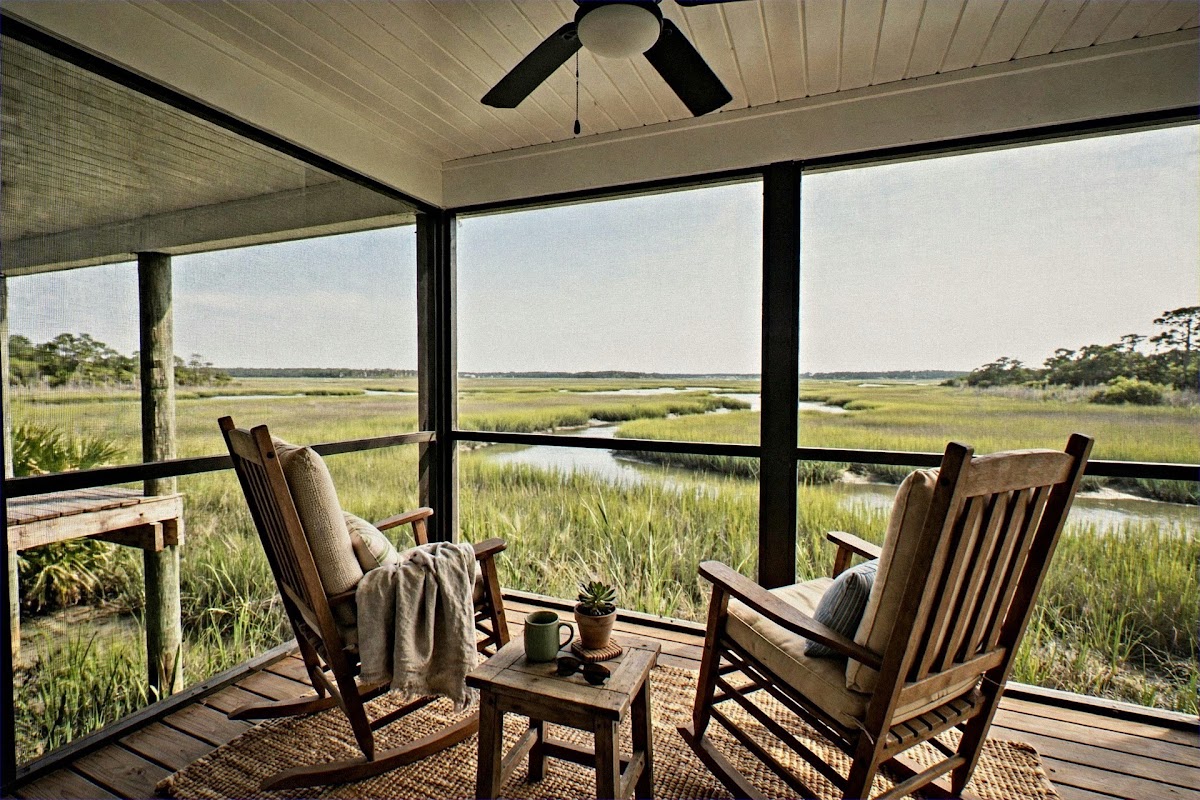
What actually helps is wonderfully low-tech: moving air. No-see-ums are weak little fliers, and a porch fan — the stronger the breeze, the better — makes your seating area a place they simply can't operate. This is why Fripp porches have fans, and why residents speak about them with genuine affection. Screens help too, though truly fine mesh matters with something this tiny; if you're screening or re-screening a porch, ask whoever's doing the work about mesh suited to tiny biting gnats, and check your FIPOA owner materials and the Architectural Review Board process before changing anything on your home's exterior — approvals come first here, even for bug-driven projects.
Long sleeves and long pants at dusk sound unglamorous and work anyway. And when the evening is dead still and the gnats are out in force, seasoned residents simply move the party indoors for a bit and let them have the twilight shift. Picking your moments is a Lowcountry art form.
Mosquitoes: The Evening Shift
Mosquitoes need no introduction — you've met — but Fripp's version comes with marshland enthusiasm. They're generally worst in the warm months, after rainy stretches, and most active around dawn and dusk, though a shady, damp afternoon can bring them out for a matinee.
The most useful habit you can build is a yard habit: mosquitoes breed in standing water, so regularly tip out anything around your house that collects rain — saucers, buckets, toys, tarps, the forgotten container behind the shed. It takes five minutes on a walk around the house, it genuinely reduces the crowd, and it makes you feel pleasingly competent.
Beyond that, the resident playbook overlaps with the no-see-um defense: fans on the porch, screens in good repair, sleeves at dusk, and timing outdoor plans with a breeze when you can. A windy beach day, by the way, is a gloriously bug-light day — one more reason the beach at a good breeze feels like pure relief.
Palmetto Bugs: Big, Startling, Mostly Harmless Roommates
Deep breath. The palmetto bug is the Lowcountry's most dramatic insect: a large roach that lives mostly outdoors in mulch, leaf litter, and trees, and occasionally wanders inside like it pays rent. It does not. It is startling because of its size, and it can fly, which feels personally unfair.
They're generally most noticeable in the warm months and after heavy rain, when outdoor life gets soggy and everybody — bugs included — goes looking for somewhere drier. An occasional indoor sighting is a normal Lowcountry experience, not a sign your house is failing. Residents keep them in check with ordinary household common sense: seal up the little gaps around doors, pipes, and windows where you can, keep door sweeps in decent shape, clear leaf litter and heavy mulch away from right against the house, and don't leave pet food sitting out overnight.
If you ever find they're frequent guests rather than rare wanderers, that's a normal moment to bring in professional help — just ask a neighbor who they use and what works on their street, the way you'd ask about any home service here. Island wisdom travels porch to porch, and bug wisdom travels fastest of all.
Fire Ants: Respect the Mound
Fire ants are the one entry on this list that demands real respect. They build loose mounds in sunny, open spots — lawns, garden edges, along paths — and if the mound is disturbed, they respond in numbers, fast, with stings that burn. Hence the name. Hence the respect.
They're generally most active in the warmer parts of the year, and mounds often pop up visibly after rain. The resident habit is simple: learn what the mounds look like, watch where you step in the yard, and teach kids and guests the same — look before you plop down on the grass. Keep an eye on the spots your dogs like to investigate, too, and steer curious noses away from mounds.
For treating mounds in your own yard, stick to widely known household wisdom applied carefully and exactly as any product's own label directs — and if you'd rather not handle it yourself, that's another perfectly normal ask-a-neighbor, bring-in-help home task. What you don't do is poke a mound to see what happens. Every Lowcountry child learns this exactly once.

The Porch Survival Playbook
Pull it all together and porch life — sacred Fripp institution — stays fully yours. Run the fans early, before the bugs clock in, not after. Keep screens in good repair. Dress for dusk in the warm months, even if it's just a light layer over your arms. Time the stillest, most humid evenings for indoor plans or a breezy beach walk instead. Do your standing-water patrol after rains. And keep a sense of humor loaded at all times: on Fripp, swatting philosophically while holding a cold drink is practically a local dance.
Notice what's not on that list: anything exotic. Porch survival here is fans, screens, habits, and timing. That's it. The bugs are a weather system, and you dress for weather.
The Honest Bottom Line
Will you get bitten your first year? Yes. Will you learn your yard, your porch, and the evening breeze patterns faster than you thought possible? Also yes. Within a season, you'll be the one telling a newer neighbor, with great authority, to turn the fan up and pass the iced tea.
Fripp gives you deer on the lawn, dolphins in the water, and stars you can actually see. In exchange, it asks you to share the twilight with some very small, very determined gnats. Every resident before you has made that trade happily — fan running, porch light glowing, evening fully enjoyed. Welcome to the club.
LIVE THE LIFE!

Get a FREE Fripp Life sticker!
Enter your email to claim your sticker and sign up for island news, events, and discounts.