
Living With Wildlife on Fripp Island: the At-Home Guide
You didn't just buy a house. You joined a neighborhood where the other residents have hooves, scales, and strong opinions about your garden. Here's how to share the yard happily.
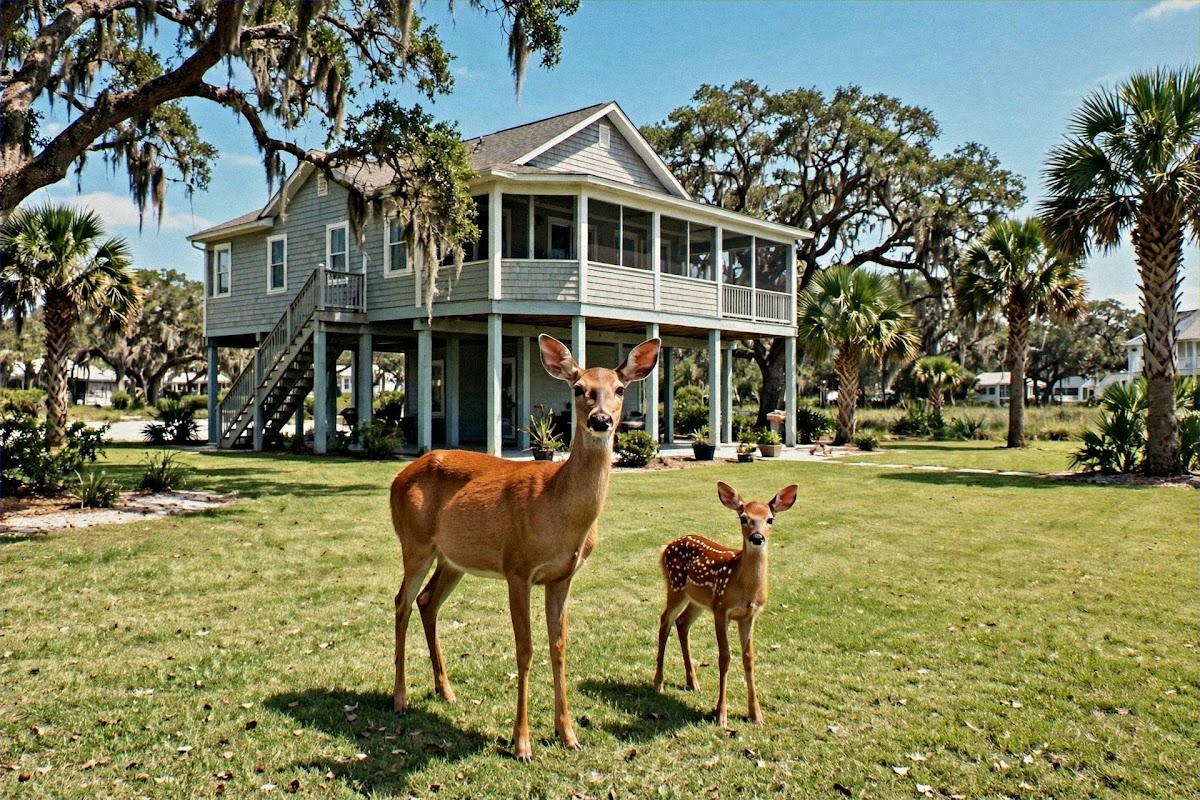
The House Rule: It's Their Island Too
Every Fripp newcomer has the moment. Maybe it's morning coffee, and a deer is standing in your yard looking at you like you're the curiosity. Maybe it's a raccoon regarding your trash can with professional interest. Maybe it's a dark, log-shaped shape in the lagoon that turns out to be very much not a log.
Welcome to the real Fripp. This island's wildlife isn't an attraction you go see — it's the community you live inside, and your house is right in the middle of it. The good news: coexistence here is easy, pleasant, and occasionally hilarious, as long as you learn a few house rules. This is the practical, at-home version — how to live alongside it all at your own address, with your own garden, trash cans, and dogs.

Alligators: Admire From a Distance, Always
Fripp's lagoons hold alligators — real ones, doing what alligators have done in Lowcountry water forever. They are fascinating, prehistoric, and best enjoyed like a good painting: from a respectful distance, without touching anything.
The rules are simple and absolute. Never feed an alligator. Not a scrap, not once, not "just this time for a photo." A fed alligator learns to associate people with food, and that lesson makes the animal dangerous and dooms it. For gators, this is the single most important rule on this page.
The lagoons are for looking, not entering. Island lagoons are no swimming, no fishing, and no crabbing — full stop. No wading, no dipping toes, no letting kids or dogs splash at the edge, no casting a line because it looks peaceful. The lagoons are the gators' living room; we admire it from the bank, the bridge, or the cart path, and give any gator a wide, unbothered berth. If one ever seems to be somewhere genuinely concerning — too close to homes or behaving unusually — don't improvise: contact Island Security or the FIPOA office and let them route it to the people who deal with such things, including SCDNR where appropriate.
Mostly, though? You'll see a gator sunning across the lagoon, feel a little thrill, take a photo from a sensible distance, and carry on with your day.
Deer: the Garden Committee Has Notes
If gators are the island's celebrities, deer are its landscaping critics. Fripp's deer graze lawns and fairways like they hold a standing reservation, and your garden — your tender, expensive, lovingly planted garden — is, in their professional opinion, a buffet you have kindly provided.
Make peace with this early and you'll be much happier. Fripp gardeners learn by cheerful trial and error which plants the deer treat as salad and which they tend to leave alone, and plan accordingly: prized plantings go where they're protected, experiments go in with low expectations, and the whole enterprise is held loosely. Ask your neighbors what survives on your street — every Fripp gardener has a list, strong opinions, and a story about a plant that lasted exactly one night. That conversation is half horticulture, half welcome-to-the-neighborhood.
And the same golden rule applies: never feed the deer. No feeders, no piles of anything, no handouts from the porch, however soulful the eye contact gets. Deer that depend on people lose their wild habits and end up worse off — an island that loves its deer protects them by letting them be deer. Enjoy them at dawn, photograph them from the porch, and let your hostas be the only contribution you make to their diet. (The hostas were a contribution whether you planned it or not. Sorry.)
Snakes: Leave Them Be, and They'll Return the Favor
Yes, there are snakes on Fripp — it's the Lowcountry, and snakes are part of a healthy ecosystem, quietly handling the rodent population on everyone's behalf. The homeowner rule is beautifully simple: leave them be. A snake in the yard wants exactly one thing: to be somewhere else, away from you. Give it room and time, and it will oblige.
Practical habits help: keep yard edges reasonably tidy so you can see where you're stepping, watch your feet in garden beds and woodpiles, and teach kids the island rule early — we look, we don't touch, we come tell a grown-up. If a snake ever turns up somewhere it truly can't stay — inside a screened porch, say — don't play hero with a broom. Back off, keep people and dogs away, and call Island Security or the FIPOA office for guidance on who handles it. Nobody will think less of you. It's the most local move you can make.
Raccoons vs. Trash Cans: the Long War
Every coastal community has this rivalry, and Fripp's raccoons are talented, motivated, and apparently unionized. They view an unsecured trash can as a puzzle box with snacks inside — and they are very good at puzzles.
Winning this war is about habits, not heroics. Keep cans secured — lids on properly, cans stored the way your home's setup intends — and follow the island's trash rhythm for when bins go out and come back in, since a can living at the curb all week is a can advertising a buffet. Your FIPOA owner materials carry the current expectations for trash at your home, so work from those rather than from old-neighborhood habit. If a can does get raided, clean it up promptly and completely; scattered trash is an invitation for an encore, and your neighbors (the human ones) will appreciate the tidy response. In time you'll develop the sixth sense every Fripp homeowner has: hearing a lid rattle at midnight and knowing exactly what it means.

Dogs: Leashes, Lagoon Edges, and Street Smarts
If you have dogs, Fripp will feel like paradise — walks everywhere, a beach with seasonal windows for dogs, a whole island to sniff. Your job is to be the brains of the operation.
The big one: keep dogs on leash and well away from lagoon edges. Dogs don't know about alligators, and a curious dog at a lagoon's water's edge is a genuinely dangerous picture. Walk lagoon-side routes with your dog leashed and beside you, never ranging ahead to the bank. The same discipline helps with deer — a dog that chases deer is headed for a road, a marsh, or an adventure you didn't plan — and with snakes, since a leashed dog walks where you walk, in the open, where you can see.
A few more habits: check the yard before letting dogs out after dark, keep them close in the evening when the island's wildlife commutes, and build the "leave it" command like it matters — on Fripp, it truly does. Dogs who learn island manners become the happiest residents of all. Just ask any porch dog holding court at sunset, supervising the deer from a safe and smug distance.
The Joy of It, Honestly
Here's what nobody warns you about: within a year, all of this becomes your favorite part. The gator you recognize. The fawn season you wait for. The raccoon you grudgingly respect. Living with wildlife on Fripp isn't a chore list — it's the daily reminder that you moved somewhere genuinely wild and genuinely gentle at once. Learn the house rules, keep your distance where distance is due, never feed anybody, and the island will keep putting on the show right outside your windows.
LIVE THE LIFE!

Get a FREE Fripp Life sticker!
Enter your email to claim your sticker and sign up for island news, events, and discounts.