
Seven Flags Over Beaufort: Five Centuries of Lowcountry Drama in One Small Town
Seven flags have flown over Beaufort, SC. Here is each wild story.
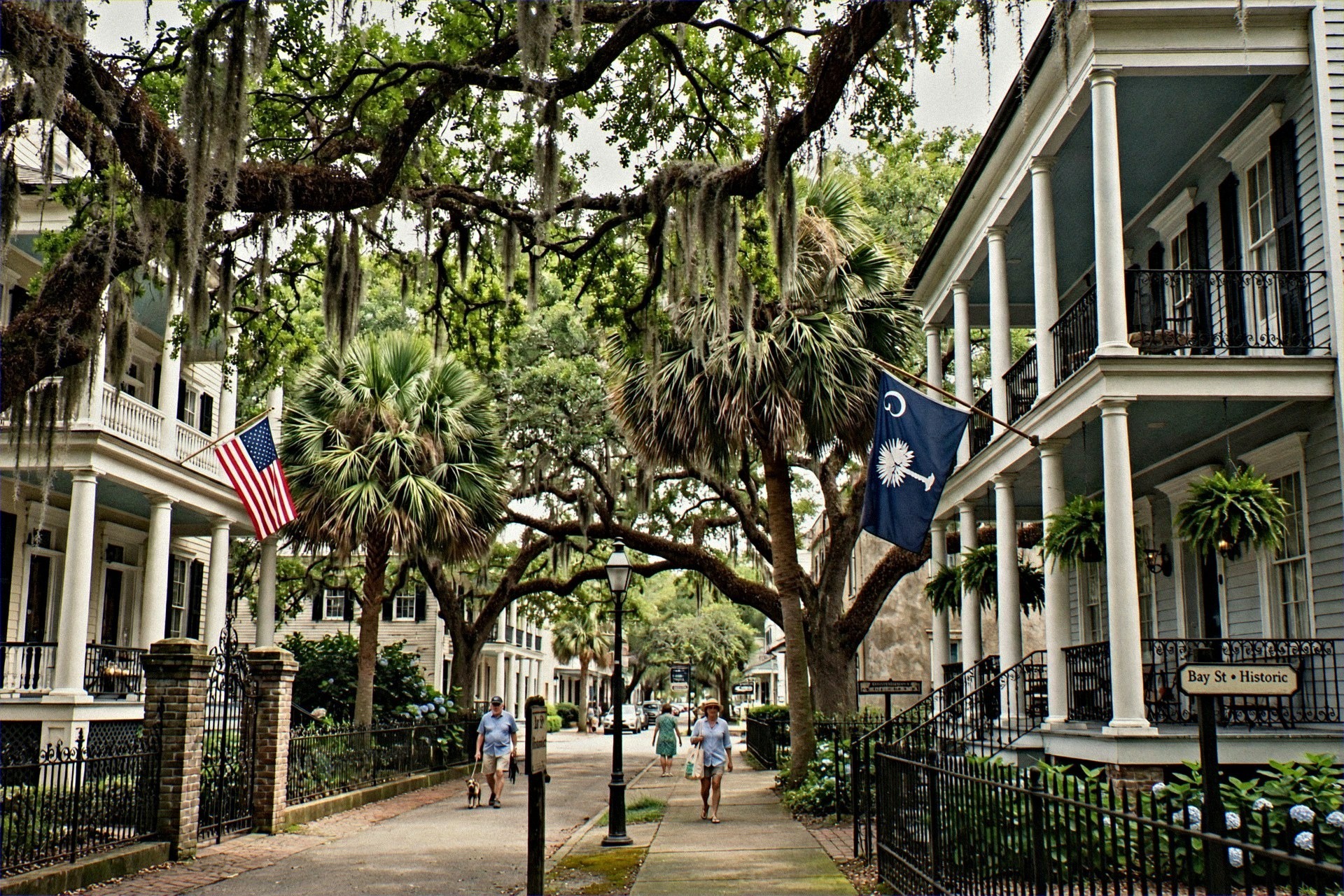
Most towns get a flag or two and call it a history. Beaufort collected seven.
Spain. France. Scotland. England. The Confederate States. South Carolina. And the United States — a lineup most cities would envy, all flown over the same few blocks of Bay Street, and every one left a story behind — exactly what the Beaufort History Museum pointed out this week. Better still, you don't have to take their word for it. All seven flags stand on display today on the grounds of the Beaufort County Sheriff's Headquarters at 1501 Bay Street, free to walk up and see.
Here comes the parade, in order.
1. Spain — the capital everybody forgot (1566)
Spanish explorers were poking around Port Royal Sound by the 1520s, and in 1566 Pedro Menéndez de Avilés planted a town on Parris Island and named it Santa Elena. This was no lonely outpost — Santa Elena was the first capital of Spanish Florida, a real town of hundreds, a full 41 years before Jamestown and 54 before Plymouth Rock. It lasted until 1587, when Spain pulled everyone south to St. Augustine and Beaufort's first act quietly closed.
2. France — first come, first gone (1562)
Actually, the French beat Spain to the harbor. In 1562, Jean Ribault sailed into the sound, named it Port Royal (a name that stuck — great branding, terrible fort), and left 28 men at a scrap of a fort called Charlesfort on Parris Island. It fell apart within a year — and the stranded garrison did the most Lowcountry thing imaginable: they built a boat and sailed it home to France. Spain later built Santa Elena right on top of their fort. Same dirt, second flag.
3. Scotland — the lost colony (1684)
In 1684, roughly 148 Scots led by Lord Cardross arrived to build Stuart's Town, a Presbyterian haven planted squarely in territory Spain still claimed. Spain noticed. In August 1686, an expedition from St. Augustine burned the town to the ground, and Scotland's Carolina experiment was over in under two years. Here's the kicker: nobody knows exactly where Stuart's Town stood. Archaeologists believe it sleeps under Beaufort's Point neighborhood, and they're still out there digging test holes looking for it. There may be a lost Scottish colony under somebody's garden. (Point neighbors, check your flowerbeds.)
4. England — the town that finally stuck (1711)
The English finally made it permanent. Beaufort was chartered in 1711 — the second-oldest city in South Carolina, named for Henry Somerset, Duke of Beaufort — and it nearly died young in the Yemassee War of 1715. It didn't. Instead it grew rich on indigo, rice and one of the finest natural harbors on the coast — a harbor so good, three other flags had taken a swing at it — and built the gorgeous streetscape of mansions that still defines downtown. The English flag flew for 65 years, the longest run of any of the first four.
5. The Confederate States — the shortest reign (1861)
South Carolina seceded in December 1860, and the Confederate flag's run over Beaufort lasted less than a year. On November 7, 1861, a Union fleet steamed into Port Royal Sound and took it in an afternoon — townspeople fled, and Beaufort became a Union town for the rest of the war. The twist? Occupation saved it. Because the Union used Beaufort as a headquarters instead of a target, the antebellum town survived the war intact while other Southern cities burned. The Confederate flag left; the beautiful buildings stayed — and we're all still driving over to see them.
6. South Carolina — the palmetto earns its place (1861)
The state flag was adopted on January 28, 1861, and it's really two Revolutionary souvenirs stitched together into one good-looking flag: the crescent from the banner William Moultrie's men fought under, and the palmetto honoring the spongy palmetto-log fort on Sullivan's Island that swallowed British cannonballs in 1776 and won the day. It's flown continuously ever since — through the war, through occupation, through everything. Of all seven, it's the one that never really left. The hometown flag, still on duty.
7. The United States — the one that stayed (1861–today)
The Stars and Stripes returned with the Union fleet in 1861, and Beaufort promptly became one of the most important places in American history that most Americans have never heard of. Freed here in large numbers at the very start of the war, thousands of enslaved people built new lives under the Port Royal Experiment; Penn School opened on St. Helena Island in 1862; and the story is now honored by the Reconstruction Era National Historical Park, with its visitor center right on Craven Street. The seventh flag is still flying — right over the Bay Street blocks where this whole parade began.
Go see them
The seven-flag display stands on the grounds at 1501 Bay Street — walk up, read the plaques, count all seven, and take the photo. Then make the short stroll to the Beaufort History Museum inside the Arsenal at 713 Craven Street, where the whole wild timeline is laid out in one building that has a few flags' worth of stories of its own.
From the Fripp Island gate, Beaufort is about a 40-minute drive — the easiest history lesson in the Lowcountry (no pop quiz, we promise) and the perfect non-beach day. Five centuries, seven flags, one small town — every one of them still waving you over. Beaufort has been collecting countries since before America was one.
Hat tip: Beaufort History Museum (@beauforthistorymuseum) for the seven-flags fact that started this rabbit hole.
LIVE THE LIFE!

Get a FREE Fripp Life sticker!
Enter your email to claim your sticker and sign up for island news, events, and discounts.